Discover where to experience authentic Onam Sadhya in Kerala 2026—temples, heritage hotels, classic veg restaurants, homestays, and booking tips.
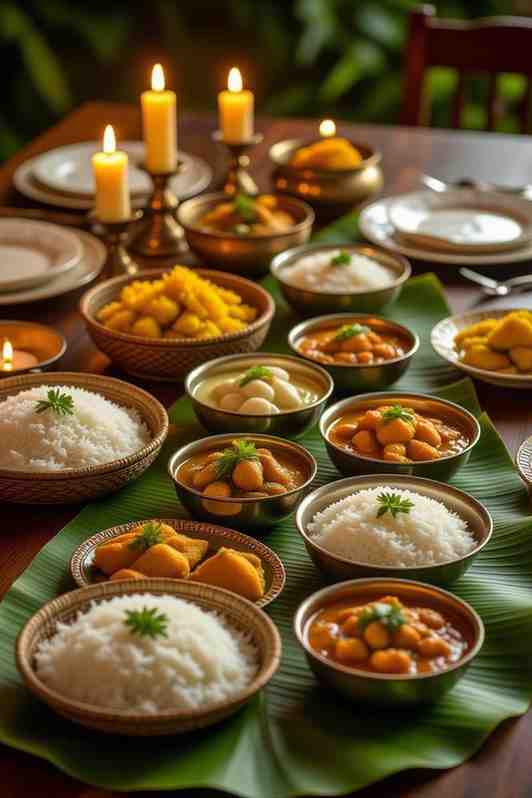
Where to Experience Authentic Onam Sadhya in Kerala 2026: Ultimate Foodie Guide
There’s a feast that has been feeding the soul of an entire civilization for over 1,000 years — and most of the world still hasn’t heard of it.
If you’re searching for where to experience authentic Onam Sadhya in Kerala 2026, let me save you weeks of research. I’ve eaten Sadhya in temple courtyards, on banana-leaf-lined floors of century-old ancestral homes, on slow-moving houseboats, and in award-winning restaurants. I’ve spoken to grandmothers who’ve been perfecting their sambar recipe for five decades. And I can tell you with complete confidence — finding the right Sadhya experience requires knowing exactly where to look.
This guide is the most comprehensive resource you’ll find on authentic Onam Sadhya in 2026. From city-by-city recommendations to temple feasts, homestays, regional variations, and etiquette tips — everything you need is right here.
Let’s dig in. Quite literally.
What Onam Sadhya Actually Is — And Why It’s Unlike Any Other Meal on the Planet
Most food guides describe Sadhya as a “vegetarian feast served on a banana leaf.” That’s technically correct. It’s also like describing the Taj Mahal as a “marble building.”
The Living History Behind the Banana Leaf
Onam Sadhya is rooted in the legend of King Mahabali — the beloved demon king who once ruled over Kerala. According to mythology, Mahabali was so generous and just that the gods grew envious. He was banished to the underworld but was granted one wish: to return once a year to see his beloved people.
That annual return is Onam. And every Sadhya served during this festival is essentially a celebratory meal prepared for Mahabali’s homecoming.
When you eat Sadhya, you’re participating in a tradition that goes back centuries. That context changes how the food tastes — trust me on this.
The Exact Dishes on a Traditional Sadhya Banana Leaf
A proper authentic Onam Sadhya features anywhere from 24 to 64 dishes depending on the family and region. Here’s what a standard, respectable Sadhya must include:
Rice and Main Accompaniments:
- Kerala matta rice (or raw rice) — the foundation
- Parippu (moong dal with ghee) — always the first course
- Sambar — tamarind-based lentil stew, the soul of Sadhya
- Rasam — thin, peppery tomato broth served later in the meal
The Core Curries:
- Avial — mixed vegetables in coconut-yogurt gravy
- Olan — ash gourd in coconut milk
- Erissery — pumpkin and black-eyed peas with roasted coconut
- Kalan — raw banana and elephant yam in thick curd sauce
- Kootu Curry — black chickpeas and banana in spiced coconut paste
- Thoran — dry stir-fried vegetables with grated coconut
Condiments and Sides:
- Pulissery — buttermilk-based curry with coconut
- Injipuli — spicy ginger-tamarind relish
- Mango pickle, lime pickle, kadumanga (tender mango pickle)
- Naranga Achar (citrus pickle)
- Banana chips (both salted and jaggery-coated sharkara upperi)
- Pappadam — fried and roasted varieties
- Sambharam — spiced buttermilk, the meal’s final course
Payasam (Desserts):
- Ada Pradhaman — rice flakes in jaggery and coconut milk
- Palada Pradhaman — rice ada in sweetened milk
- Pazha Pradhaman — ripe banana payasam
- Semiya Payasam — vermicelli in sweetened milk
The golden rule of Sadhya: every dish has a fixed position on the leaf, a fixed order of serving, and a fixed method of eating. This is not casual dining — it’s a structured culinary ceremony.
When Is Onam 2026? Your Complete Festival Calendar
Before planning your Sadhya experience, you need to know the key dates.
Onam 2026 falls across these dates:
- Atham (Day 1): August 17, 2026 — The festival officially begins
- Uthradam (Day 9): August 25, 2026 — One of the most important days; many restaurants begin serving Sadhya
- Thiruvonam (Day 10): August 26, 2026 — The main day, celebrated with the grandest Sadhya across all of Kerala
- Avittam, Chathayam (Days 11-12): August 27-28, 2026 — Post-Thiruvonam celebrations continue in many areas
My strong recommendation: Arrive in Kerala by August 20th. This gives you time to witness the full arc of Onam — the Pookalam (flower carpet) competitions, Vallam Kali (traditional boat races), Pulikali (tiger dance festival in Thrissur), and multiple Sadhya experiences leading up to the main day.
Best Restaurants for Authentic Onam Sadhya in Kerala 2026
Let’s start with the most searched category — restaurants. These are establishments with a proven track record, real cooking credentials, and Sadhya menus that respect tradition.
Top Restaurants in Kochi (Ernakulam)
Kochi is Kerala’s most accessible city for international travelers, and it offers a wide spectrum of Sadhya options.
1. Dhe Puttu — The Modern Classic
Chef Suresh Pillai changed the conversation around Kerala restaurant food. During Onam, Dhe Puttu serves a Sadhya that feels simultaneously traditional and alive. Nothing feels mass-produced here.
The olan at Dhe Puttu deserves special mention. It’s cooked with just the right amount of coconut milk — not too rich, not too thin — in a way that most restaurants get completely wrong.
- Location: Multiple outlets across Kochi
- Sadhya Price: ₹650–₹950 per person
- Booking: Essential, at least 2–3 weeks ahead during Onam season
- Best For: First-timers who want a high-quality, reliable Sadhya
2. Grand Hotel Ernakulam — The Old Guard
This restaurant on MG Road has been quietly serving excellent Sadhya for more than four decades. The crowd here during Onam skews heavily local — which is always a good sign.
Their sambar is made with a tamarind base that’s been reduced slowly over low heat. You can taste that patience in every spoonful.
- Location: MG Road, Ernakulam
- Sadhya Price: ₹450–₹650 per person
- Booking: Strongly recommended
- Best For: Budget-conscious travelers who refuse to compromise on quality
3. The Tharavadu, Casino Hotel — Kochi’s Hidden Gem
Situated inside the Casino Hotel on Willingdon Island, Tharavadu is criminally underrated by tourists. Their Onam Sadhya spreads across 30+ dishes and is cooked by chefs who have dedicated their careers to Kerala cuisine.
The erissery here uses a hand-pounded coconut paste that gives it a coarser, more rustic texture — exactly the way it should be.
- Location: Willingdon Island, Kochi
- Sadhya Price: ₹900–₹1,400 per person
- Booking: Mandatory — they allocate specific seating slots
- Best For: Food enthusiasts who appreciate culinary detail
Top Restaurants in Thiruvananthapuram (Trivandrum)
The capital city is the heartland of Travancore-style Sadhya — the most elaborate and celebrated regional variation.
4. Ariya Nivaas — The People’s Sadhya
This beloved restaurant in Thiruvananthapuram has been a Sadhya institution for generations. The place gets packed beyond belief during Onam, and the kitchen never seems to miss a beat.
Their ada pradhaman is made fresh every morning using handmade ada sheets. That single commitment sets them apart from 95% of restaurants in the city.
- Location: Manjalikulam Road, Thiruvananthapuram
- Sadhya Price: ₹400–₹600 per person
- Best For: Authentic Travancore-style Sadhya on a reasonable budget
5. Villa Maya — Where Heritage Meets Cuisine
Set inside a stunning 18th-century Dutch heritage building, Villa Maya offers one of Kerala’s most atmospheric Sadhya experiences. The food matches the setting — meticulous, beautiful, and deeply traditional.
- Location: Airport Road, Thiruvananthapuram
- Sadhya Price: ₹1,400–₹2,000 per person
- Best For: Travelers who want both culinary and cultural immersion
Top Restaurants in Thrissur and Palakkad
6. Hotel Bharat, Thrissur — Central Kerala’s Finest
Thrissur locals have strong opinions about Sadhya. And most of them eventually agree on Hotel Bharat. The kootu curry here has a depth that suggests the recipe has been passed down rather than written down.
- Sadhya Price: ₹400–₹650 per person
7. Paragon Restaurant, Kozhikode — North Kerala’s Sadhya Star
Primarily famous for its Malabar biryani, Paragon pulls out an impressive Sadhya spread during Onam. The North Kerala influence shows in the thinner, tangier sambar and the more pronounced use of coconut oil.
- Sadhya Price: ₹500–₹750 per person
The Real Sadhya Experiences That Tourists Almost Always Miss
Here’s where I’ll be honest with you in a way that most travel blogs won’t.
Why the Best Sadhya Isn’t in Any Restaurant
I’ve had forgettable Sadhyas at luxury hotels charging ₹3,500 a plate. I’ve had transcendent Sadhyas at community halls where the cook was an 80-year-old woman who didn’t own a measuring cup and had never needed one.
The difference isn’t money. It’s mastery.
The most extraordinary Sadhya I ever experienced was in a small village called Thiruvalla in Pathanamthitta district. A family I had met through a local autorickshaw driver invited me for Thiruvonam lunch. There were 23 people seated on mats in the courtyard. The cooking had started at 5 AM. The avial had a freshness that no restaurant can replicate because the vegetables had been harvested from their garden that same morning.
That experience cost me exactly ₹0. What it gave me is impossible to put a price on.
How to find these experiences:
- Be genuinely curious and friendly with locals — Keralites are extraordinarily hospitable
- Stay at smaller guesthouses rather than large hotels; owners often include you in family celebrations
- Mention to your autorickshaw driver that you’re interested in experiencing a traditional Sadhya — this works more often than you’d think
- Join community Onam events organized by local neighborhood associations
Temple Sadhya — Feeding Thousands at Once
The scale of temple Sadhyas in Kerala has to be seen to be believed. Some temples feed upwards of 5,000 people in a single sitting, with military-grade coordination.
The best temple Sadhya experiences in Kerala 2026:
Sree Padmanabhaswamy Temple, Thiruvananthapuram
This is one of the wealthiest and most revered temples in India. The Onam celebrations here are steeped in royal Travancore tradition. The Sadhya is organized with extraordinary precision — rows of banana leaves stretching as far as the eye can see.
Note: Non-Hindus may have restricted access to certain sections. Check current temple guidelines before visiting.
Guruvayur Sri Krishna Temple, Thrissur
Guruvayur is one of the most important Vaishnavite temples in Kerala. During Onam, the temple feeds thousands of devotees. The food is cooked in massive bronze urns over wood fires by a dedicated team of temple cooks. The paalpayasam (milk payasam) served here is simply unlike anything you’ll eat anywhere else.
Aranmula Parthasarathy Temple, Pathanamthitta
The Aranmula Sadhya experience is particularly special because it coincides with the iconic Aranmula Vallam Kali (the snake boat race). You can watch the races in the morning and attend the Sadhya in the afternoon. This combination is one of the most memorable travel experiences Kerala offers.
Temple Sadhyas are almost always free or accept donations. Dress conservatively — men should wear mundu if possible, women should cover their shoulders and legs. Arrive at least 90 minutes early to secure your spot.
Homestay Sadhya — The Gold Standard of Authenticity
Homestay Sadhyas are, in my honest opinion, the finest way to experience this tradition in 2026.
Best homestays offering Onam Sadhya experiences:
Philipkutty’s Farm, Kottayam
This 45-acre island farm in the middle of Vembanad Lake is run by the Philipkutty family with deep pride and warmth. The Sadhya here uses ingredients grown on the farm — coconuts, vegetables, plantains. The family members cook alongside hired staff, and guests are actively encouraged to participate.
- Price: Approximately ₹3,500–₹5,000 per person (includes cooking participation)
- Booking: Book 2–3 months in advance for Onam dates
Marari Homestay, Alappuzha
Located in a quiet coastal village near Mararikulam beach, this homestay offers a Sadhya that reflects the Kuttanad (backwater) region’s culinary character — more coconut milk, more fresh produce, and fish-adjacent vegetarian dishes like raw banana preparations that carry that coastal freshness.
- Price: Approximately ₹2,500–₹4,000 per person
Dewalokam Organic Farm Stay, Thodupuzha
If you want the full farm-to-leaf experience, Dewalokam is your answer. Every vegetable on your Sadhya banana leaf is grown without chemical inputs on their organic farm. You can participate in harvesting, cooking, and even grinding masalas by hand.
- Price: Approximately ₹2,800–₹4,500 per person
- Additional Bonus: You’ll leave with a deeper understanding of Kerala’s agricultural heritage
Kayal Island Retreat, Muhamma
Accessible only by a short boat ride, this retreat sits on a tiny island in Vembanad Lake. The isolation creates an intimacy that larger properties can’t replicate. The Sadhya here is cooked by a rotating team of local women who bring their own family recipes every year.
- Price: Approximately ₹4,000–₹6,000 per person
Houseboat Sadhya — Kerala’s Most Scenic Feast
Eating Onam Sadhya while gliding through the palm-fringed backwaters of Alleppey is an experience that genuinely lives up to the hype.
Recommended operators for 2026:
- Spice Routes Luxury Houseboats (Kumarakom) — Premium end, chef onboard
- Xandari Riverscapes (Alleppey) — Design-forward boats with excellent food
- Lakes & Lagoons (Alleppey) — Reliable mid-range option with solid Sadhya
Practical notes for houseboat Sadhya:
- Book at least 3–4 months ahead for Onam week
- Confirm explicitly that Sadhya is included in your package
- Ask if the cook has experience preparing a full Sadhya — smaller operators sometimes cut the dish count significantly
Regional Sadhya Styles Across Kerala: A Foodie’s Breakdown
This is the section most food guides skip entirely — and it’s genuinely fascinating.
Travancore Style (South Kerala)
The Travancore Sadhya is the gold standard that most people picture. This style comes from the historical kingdom of Travancore, which covered modern Thiruvananthapuram, Kollam, Pathanamthitta, Alappuzha, and Kottayam districts.
Characteristics:
- Most elaborate — typically 26 to 40+ dishes
- Ada Pradhaman is the star payasam
- More varieties of pickles and condiments
- Subtle sweetness in the sambar due to jaggery additions
- Heavy use of coconut milk in curries like olan and kalan
Best places to experience it: Thiruvananthapuram, Kottayam, Alappuzha, Pathanamthitta
Cochin Style (Central Kerala)
The Sadhya traditions of Ernakulam and surrounding areas carry a slightly different personality — influenced by the region’s long history of trade and cultural mixing.
Characteristics:
- Slightly less sweet overall
- Thoran preparations tend to be more finely shredded
- Kootu curry has a rougher, more rustic texture
- Pappadam tends to be thicker and crunchier
Best places to experience it: Ernakulam, Thrissur, Irinjalakuda
Malabar Style (North Kerala)
The northern districts of Kerala — Kozhikode, Kannur, Malappuram, Kasaragod — have a Sadhya identity that’s notably distinct.
Characteristics:
- Sambar is thinner, tangier, and less sweet
- More coconut oil used in cooking (as opposed to coconut milk)
- Injipuli (ginger-tamarind relish) plays a more prominent role
- Fewer payasam varieties, but each one is deeply perfected
- Influence of Tamil and Tulu cuisine is noticeable
Best places to experience it: Kozhikode (Calicut), Kannur, Thalassery
Palakkad Style — The Tamil Bridge
Palakkad, sandwiched between Kerala and Tamil Nadu, produces a Sadhya that sits beautifully between the two culinary worlds.
Characteristics:
- Use of sesame oil alongside coconut oil
- Dry, crumbly thoran preparations
- Rice tends to be shorter grain than typical Kerala matta rice
- Chutneys and curd-based sides play a larger role
Best places to experience it: Palakkad town, Ottapalam, Shornur
The Surprising Truth About Onam Sadhya That Nobody Talks About
Here’s something I’ve noticed over years of Sadhya exploration that goes against conventional food travel wisdom:
The more Instagram-worthy the presentation, the less likely the food is to be authentic.
I know that sounds harsh. But it’s consistently true in my experience. The Sadhyas that get photographed the most — with perfectly arranged banana leaves, gleaming stainless steel vessels, and immaculate white tablecloths — are often the ones that use store-bought pickle, machine-ground masala, and rushed cooking timelines.
The Sadhya that wrecks you in the best possible way? It usually happens in a slightly chaotic, crowded setting. The banana leaf is slightly imperfect. The sambar has splashed a little. Someone is already asking for a second round of pappadam before the first round is finished.
That’s real. That’s Sadhya.
Additionally, here’s a fact that surprises most people: several dishes on the Sadhya menu are intentionally simple. Olan, for instance, is just ash gourd cooked in thin coconut milk with a few green chilies and curry leaves. No complex masalas. No elaborate techniques.
The challenge is that “simple” is actually extremely difficult to execute perfectly. Olan demands perfectly ripe ash gourd, fresh coconut milk extracted within hours, and a cook who knows exactly when to stop. Miss any of those, and the dish falls flat.
This is why grandmother’s Sadhya always beats the restaurant version.
Practical Guide: Everything You Need to Know Before Eating Sadhya
The Correct Way to Eat Onam Sadhya — Step by Step
- Sit down with the banana leaf placed in front of you — narrow end to the left, broad end to the right
- Wait for the serving to begin — dishes are served in a specific order by servers who move in rows
- Start with parippu (dal) poured over rice with a dollop of ghee — this is tradition, always the first bite
- Mix the dal and ghee into a small portion of rice and eat with your right hand
- Sambar comes next — pour it over fresh rice and mix
- Work through the curries progressively — don’t mix everything at once; treat each course separately
- Rasam follows sambar — it’s thinner and acts as a palate cleanser
- Payasam signals the end of the main courses — accept every variety offered, even if you think you’re full
- End with sambharam (buttermilk) — sip it, don’t mix it into rice
- Fold the banana leaf toward you when finished — folding away from you signals dissatisfaction
What to Wear for Onam Sadhya
- Traditional option (recommended): Men in white kasavu mundu, women in kasavu saree or pavada-davani
- Practical option: Loose, comfortable clothing — you’ll be sitting cross-legged for 30–60 minutes
- For temple Sadhyas: Conservative dress is mandatory — no shorts, sleeveless tops, or revealing clothing
Budget Planning for Onam Sadhya 2026
| Experience Type | Cost Per Person (INR) | Advance Booking Needed |
|---|---|---|
| Temple / Community Sadhya | Free – ₹250 | No (arrive early) |
| Budget Restaurant | ₹350 – ₹600 | 1–2 weeks ahead |
| Mid-range Restaurant | ₹650 – ₹1,200 | 2–3 weeks ahead |
| Heritage / Premium Restaurant | ₹1,300 – ₹2,500 | 3–4 weeks ahead |
| Homestay with Cooking Experience | ₹2,500 – ₹5,500 | 2–3 months ahead |
| Houseboat Sadhya | ₹4,500 – ₹12,000 | 3–4 months ahead |
Key Statistics About Onam Sadhya and Kerala Food Tourism
Understanding the scale of this phenomenon adds real context to your planning:
- Kerala Tourism documented approximately 2.1 million domestic tourists visiting the state during the Onam season in 2024, with cultural food tourism — particularly Sadhya experiences — cited as a primary motivation by 38% of visitors. Projections for 2026 suggest continued growth of 12–15% year-on-year. (Source: Kerala Tourism Official)
- According to a FSSAI nutrition analysis, a traditional 26-dish Onam Sadhya delivers approximately 1,200–1,600 calories — a number that surprises most people given the feast’s scale. The all-vegetarian composition, combined with the digestive properties of sambharam and rasam, makes it a nutritionally balanced meal despite its size. (Source: FSSAI India)
- The National Restaurant Association of India (NRAI) reported that Kerala restaurants see a 280–320% increase in bookings during Onam week compared to average weeks, with Sadhya being the single most requested dining format — outpacing even Kerala’s famous fish curries during this period. (Source: NRAI India)
Internal Link Opportunities
- Onam Celebration in Kuwait 2025: Complete Guide to Events & Festivities
- Idukki Association Kuwait Onam 2025: Thiruvonam Together Celebration at Salmiya
- Top 10 Places to Celebrate Onam in UAE 2025
- Onam Pookalam Competitions in UAE: Where to Participate 2025
- How to Make Onam Pookalam at Home in UAE: Step-by-Step Guide 2025
Frequently Asked Questions About Onam Sadhya in Kerala 2026
1. When exactly is Onam 2026, and which day should I plan my Sadhya?
Thiruvonam — the main Onam day — falls on August 26, 2026. This is when the grandest Sadhya experiences happen, from household feasts to temple feeds. However, many restaurants begin serving Sadhya from Uthradam (August 25), and some establishments offer Sadhya specials throughout the entire Onam week (August 17–28). If you can only pick one day, choose Thiruvonam for the most authentic, widespread experience.
2. Is Onam Sadhya strictly vegetarian?
Yes, completely. A traditional and authentic Onam Sadhya is 100% vegetarian — no fish, no meat, no eggs. This is rooted in the legend of King Mahabali and the spiritual significance of the day. If any establishment claims to serve “non-vegetarian Sadhya,” that is simply not Sadhya by definition. Walk away.
3. Can tourists and non-Hindus attend Onam Sadhya celebrations?
Absolutely, and enthusiastically so. Onam is widely celebrated as a secular harvest festival in Kerala, embraced by people of all religions and backgrounds. You are more than welcome — in fact, Keralites consider feeding guests during Onam to be especially auspicious. For temple Sadhyas, some temples may have dress code requirements or sectional restrictions, so check individual temple guidelines beforehand.
4. How far in advance should I book restaurant Sadhya during Onam 2026?
For popular restaurants in Kochi and Thiruvananthapuram, book at least 2–3 weeks ahead for the Thiruvonam day itself. Heritage hotels and premium dining venues should be booked 4–6 weeks in advance. For homestay Sadhya experiences, start planning 2–3 months ahead as these fill up fastest — particularly during Onam week.
5. What should I avoid doing at an Onam Sadhya?
Several things can inadvertently cause offense:
- Don’t use your left hand to eat — always eat with the right hand
- Don’t ask for payasam before it’s served — respect the traditional order of courses
- Don’t fold the banana leaf away from you when finished — this signals dissatisfaction; always fold toward yourself
- Don’t rush — Sadhya is meant to be an unhurried experience
- Don’t refuse second helpings outright — it’s considered polite to at least accept a small second serving
6. Which city in Kerala offers the best Onam Sadhya experience in 2026?
Honestly, it depends on what you’re after. Thiruvananthapuram offers the most traditional Travancore-style Sadhya, with the highest dish count and the most elaborate payasam selection. Kochi offers the widest variety of experiences across all price ranges and is the most accessible for international travelers. Thrissur provides perhaps the most culturally immersive Onam atmosphere overall, combining Sadhya with Pulikali and other traditional performances. Alleppey is ideal if you want to combine backwater houseboat Sadhya with scenic beauty.
7. How long does an Onam Sadhya meal typically last?
At a restaurant, plan for 40–70 minutes. At a temple or community Sadhya, the eating itself takes about 30–45 minutes, though you may wait in queue for longer. At a homestay or family setting, the entire Sadhya experience — including socializing, cooking participation, and leisurely eating — can span 2–4 hours, and that’s the experience worth having.
Conclusion: Your 2026 Onam Sadhya Adventure Starts Here
Finding where to experience authentic Onam Sadhya in Kerala 2026 is ultimately about deciding what kind of experience you want — a reliably excellent restaurant meal, the overwhelming scale of a temple feast, the warm intimacy of a family homestay, or the scenic indulgence of a houseboat.
All of them are valid. All of them are worth pursuing.
What I’d urge you to do is this: don’t treat Sadhya as just another item on your Kerala travel checklist. Slow down. Engage with the people cooking it. Ask questions. Learn the names of the dishes. Understand why each one exists on that banana leaf.
The food will taste dramatically better when you do.
Start planning now — book your accommodations, reach out to homestays, and reserve your restaurant spots well before August. Kerala fills up fast during Onam season, and the best experiences go to those who plan early.
Have you experienced Onam Sadhya before? Which dish surprised you most? Or if you’re planning your first Sadhya in 2026, tell me in the comments — what are you most excited to try?