Find the best Onam pookalam competitions and designs in Kerala 2026—dates, rules, judging, flower sourcing, humidity hacks, and winning templates.
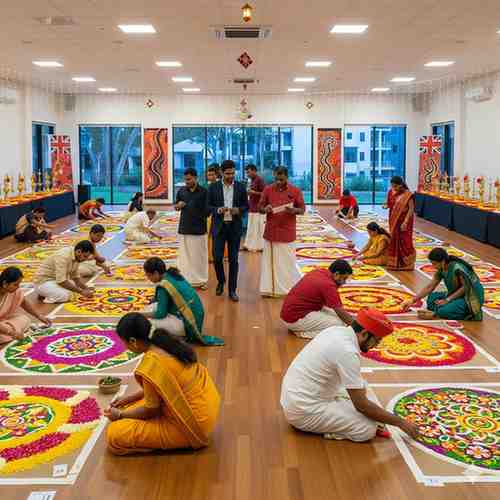
Best Onam Pookalam Competitions and Designs in Kerala 2026: Complete Guide
A ten-year-old girl in Thrissur spent three weeks sketching her Pookalam design on graph paper before a single flower touched the ground. She won her school competition that year — beating teams twice her size with a design so geometrically precise that her teacher photographed it before it was swept away.
That story tells you everything about what Onam Pookalam means to Kerala.
The best Onam Pookalam competitions and designs in Kerala 2026 are shaping up to be more spectacular than ever. With Thiruvonam falling on August 26, 2026, communities, schools, companies, and cultural organizations across the state are already beginning to think about their designs, source their flowers, and assemble their teams.
This guide is your complete resource — whether you’re a visitor wanting to witness the most breathtaking Pookalam displays in Kerala, a participant looking for design inspiration and competition tips, or simply someone who loves this tradition and wants to understand it more deeply. Everything you need to know is right here.
What Is Onam Pookalam? The Art Form That Defines Kerala’s Festival Season
Most people know Pookalam as the “flower carpet” of Onam. But that description barely scratches the surface of what this tradition actually represents.
The Deep Meaning Behind Every Petal
Pookalam comes from two Malayalam words: Poo (flower) and Kalam (floor design or pattern). Together, they describe a rangoli-style floral arrangement created on the ground — but the cultural weight it carries goes far beyond decoration.
According to the legend of Onam, King Mahabali returns to visit his beloved kingdom once a year during Thiruvonam. The Pookalam is Kerala’s way of welcoming him — a gift of beauty laid at the threshold of every home, every school, every temple, and every public space.
In this context, the Pookalam isn’t just an art project. It’s an act of devotion, a message of love sent across the mythological boundary between the mortal world and wherever Mahabali’s soul now resides.
Every family in Kerala maintains this tradition differently. Some households keep their Pookalam small and simple — a single ring of marigolds in the courtyard. Others create elaborate multi-ring designs with 15 or 20 flower varieties arranged in precise concentric circles. And then there are the competition-grade Pookalams — massive, technically stunning creations that can span 20 feet in diameter and take teams of 10–20 people an entire day to complete.
How Pookalam Has Evolved Over Generations
Traditional Pookalams were almost exclusively floral — fresh flowers arranged on the ground in patterns derived from temple art, kolam (rice flour drawings), and natural geometry.
However, Onam Pookalam designs have evolved significantly over the past two decades. Contemporary competition Pookalams now incorporate:
- Thematic storytelling — depicting scenes from the Mahabali legend, Kerala’s natural landscapes, or social messages
- 3D elements — raised flower structures, sculpted floral forms, and layered arrangements that create depth
- Color gradient techniques — sophisticated shading using multiple shades of the same flower variety
- Portrait Pookalams — photorealistic portraits of deities, leaders, or nature scenes created entirely from flower petals
- Eco-themed designs — using sustainable, locally sourced flowers to make environmental statements
The shift from purely geometric Pookalams to thematic, narrative, and even photorealistic designs is one of the most fascinating creative evolutions in any traditional Indian art form. What began as temple-influenced geometry has become, in competition spaces, something closer to contemporary installation art.
The Onam Pookalam Season 2026: When Does It Start and End?
Understanding the Pookalam timeline is essential for both participants and visitors.
The Ten-Day Pookalam Tradition
One of the most beautiful aspects of Onam Pookalam is that it’s not a single-day event. The tradition runs across the ten days of Onam, starting from Atham and culminating on Thiruvonam.
The 2026 Onam Pookalam Calendar:
| Onam Day | Date (2026) | Pookalam Significance |
|---|---|---|
| Atham (Day 1) | August 17 | First small Pookalam laid — usually just one or two flower rings |
| Chithira (Day 2) | August 18 | Second ring added |
| Chodhi (Day 3) | August 19 | Third ring added |
| Vishakam (Day 4) | August 20 | Fourth ring added |
| Anizham (Day 5) | August 21 | Fifth ring added |
| Thriketa (Day 6) | August 22 | Sixth ring added |
| Moolam (Day 7) | August 23 | Seventh ring added |
| Pooradam (Day 8) | August 24 | Eighth ring added |
| Uthradam (Day 9) | August 25 | Ninth ring — the day before Thiruvonam; many competitions happen today |
| Thiruvonam (Day 10) | August 26 | The grandest Pookalam of all — the final, most elaborate design |
This daily addition of rings means that by Thiruvonam, a traditionally maintained household Pookalam has been built up layer by layer over ten days. Each new ring represents the growing anticipation of Mahabali’s arrival.
Additionally, this progressive structure means the Pookalam changes every single day. Visiting the same household on Day 3 and Day 9 gives you two completely different visual experiences.
Best Onam Pookalam Competitions in Kerala 2026: Where to Watch and Participate
Kerala takes Pookalam competitions extraordinarily seriously. Some of the state’s largest events draw national media attention and attract participants who have been training and planning for months.
Thrissur Pooram Grounds — Athapookalam Competition
Thrissur is arguably the cultural capital of Kerala, and its Onam celebrations match that status. The Athapookalam competition organized by the Thrissur Corporation and associated cultural committees is one of the largest organized Pookalam competitions in the state.
The event typically spans the full Onam period, with preliminary rounds on Atham and finals on Thiruvonam. The competition site near the famous Thrissur Pooram grounds transforms into a gallery of floral art — with dozens of teams working simultaneously in designated spaces.
What makes it special:
- Professional judges drawn from fine arts institutions evaluate entries
- Categories for schools, colleges, neighborhood associations, and open teams
- Live commentary explaining design choices and execution techniques
- Awards ceremony with significant prize money and trophies
- Free entry for spectators
Visitor Tip: Arrive on Uthradam (August 25) to witness the final preparations before Thiruvonam. Teams often work through the night to complete their largest designs, and the early morning hours before judging begins are magical — teams in focused silence, working by lamp and phone light.
Thiruvananthapuram — Government-Organized State Competitions
The Kerala state government, through its Department of Cultural Affairs and Kerala Tourism, organizes official state-level Pookalam competitions that draw participation from all 14 districts.
These competitions are held at prominent public venues in Thiruvananthapuram — typically near Napier Museum, the historic Kanakakunnu Palace grounds, or the Nishagandhi Cultural Centre.
Key features:
- District-level winners compete at the state level
- Judging criteria are published in advance and thoroughly standardized
- Categories include traditional (only natural flowers), contemporary (mixed materials), thematic, and institutional
- Winners receive state recognition, cash awards, and certificates from cultural authorities
- Events are broadcast on Kerala government television channels
How to participate (2026):
- Registration typically opens 4–6 weeks before Onam
- Contact the Kerala Department of Cultural Affairs or your district cultural office for registration forms
- Institutional participants (schools, colleges, companies) must register through their respective umbrella organizations
Kochi — Corporate and Institutional Pookalam Competitions
Kochi’s modern, cosmopolitan character gives its Pookalam competitions a distinctive flavor. Here, corporate offices, IT parks, shopping malls, and cultural organizations compete alongside traditional neighborhood associations.
Notable Kochi Pookalam events in 2026:
InfoPark and Technopark Onam Competitions
Kerala’s major IT parks — InfoPark in Kochi and Technopark in Thiruvananthapuram — organize internal company Pookalam competitions that have become incredibly competitive. Teams from individual companies and departments compete for trophies that, to those who know, carry significant workplace prestige.
The designs here often blend traditional Kerala motifs with contemporary themes — technology, environment, Kerala’s landscapes — reflecting the creative sensibility of participants who straddle traditional culture and modern professions.
Lulu Mall, Kochi — Public Pookalam Display
Lulu Mall in Kochi organizes one of the most visited public Pookalam displays in the city during Onam. The central atrium is transformed into a showcase of professional-grade floral art, with daily fresh installations throughout the Onam week. Free for visitors.
Marine Drive Pookalam Festival
The Marine Drive waterfront in Ernakulam hosts a community Pookalam festival during Onam that’s worth visiting purely for the setting — elaborate flower carpets laid against the backdrop of Vembanad Lake is a visual that stays with you.
Alappuzha (Alleppey) — The Backwater Pookalam Experience
Alappuzha, the Venice of the East, brings its own unique character to Pookalam traditions. Given the city’s layout of canals and backwater-adjacent neighborhoods, many Pookalams here are created right at the edge of the water — a composition that’s uniquely photogenic.
The Alappuzha District Tourism Promotion Council organizes waterfront Pookalam competitions that combine the flower art tradition with the region’s backwater aesthetic. Some of the most photographed Onam images in recent years have come from Alappuzha’s canal-side Pookalams.
School and College Competitions — Where the Future of Pookalam Is Being Written
Across Kerala, every school and college organizes its own Pookalam competition during Onam. These events are where the next generation of Pookalam artists develop their skills.
The school competitions I’ve witnessed have consistently surprised me with their ambition. Students who spend weeks designing on graph paper, who source flowers from their grandmothers’ gardens, who wake at 5 AM on competition day to begin laying — these young participants take this as seriously as any inter-state athletic competition.
The Kerala School Kalolsavam (the state’s massive school arts festival) includes Pookalam as a competitive category, and performances at this level travel through district, regional, and state rounds. Winners at the state Kalolsavam level achieve genuine celebrity status among their peers.
Onam Pookalam Designs 2026: The Complete Design Guide
This is the section where Pookalam participants — both beginners and experienced designers — will find the most practical value.
Traditional Pookalam Designs — The Foundation You Must Know
Before experimenting with contemporary styles, understanding traditional Pookalam design principles is essential. These patterns have been refined over centuries and contain a geometric wisdom that’s worth mastering.
Classic Traditional Pookalam Patterns:
1. Ashtadalam (Eight-Petal Lotus)
The most iconic traditional Pookalam design. Eight elongated petals radiate from a central circular hub, creating a lotus form that symbolizes purity and divine presence. This design scales beautifully from small household sizes to large competition formats.
How to execute it well:
- Use a central circle of uniform size as your anchor
- Measure the eight petal positions using string and chalk before laying flowers
- The petal tip should be approximately 1.5x the radius of your central circle
- Use a contrasting flower color for petal outlines versus fills
2. Chakra (Wheel Design)
Concentric circles divided by straight lines radiating from the center — creating a wheel or mandala effect. This is technically one of the most demanding traditional designs because the uniformity of the circles must be perfect.
How to execute it well:
- A compass made from string and a chalk stick is your best friend
- Complete each full circle before beginning the next
- Work from the center outward, not outside in
3. Patthayam (Step Design)
A design based on step-like geometric progressions that create an optical illusion of depth. Popular in competitions because it rewards technical precision with visual impact.
4. Tharavaad (Ancestral Home) Design
A design that incorporates architectural elements of the traditional Kerala ancestral home (Naalukettu) into the Pookalam pattern. This design has deep emotional resonance for judges and audiences who recognize the reference.
5. Sopaanam (Sacred Steps)
Inspired by the stepped entrances of Kerala temples, this design creates a series of ascending geometric bands that converge at a central apex. Often used in larger competition designs as a structural framework.
Contemporary and Thematic Pookalam Designs for 2026
Modern competition Pookalams have moved well beyond pure geometry. Here are the design directions that are generating the most attention heading into 2026:
Portrait Pookalams — The Technical Summit
Creating a photorealistic portrait using only flower petals, leaves, and natural materials is the most technically demanding Pookalam format. Successful portrait Pookalams require:
- A grid-scaled reference design on paper before execution
- Color mapping — identifying which flowers will represent which tones in the portrait
- A team large enough to execute all sections simultaneously (lone workers lose consistency)
- Extreme precision in petal placement — individual petals are often placed one at a time using tweezers or pointed sticks
Notable portrait subjects for 2026 Pookalams:
- King Mahabali (the traditional subject)
- Kerala’s natural landscapes — elephant, peacock, Kathakali dancer
- Environmental subjects — tigers, water, forest conservation themes
- Kerala’s cultural icons
Kerala Map Pookalam
A perennial competition favorite — the outline of Kerala’s map created in flowers, with notable landmarks, rivers, and cultural symbols depicted within. This design works because every judge and spectator immediately understands and connects with the reference.
Eco and Environmental Message Pookalams
Increasingly popular as environmental awareness grows. These designs depict threatened wildlife, degrading ecosystems, or climate change messages — using the beauty of flowers to underscore the urgency of preservation. Judges consistently respond well to this category.
3D and Sculptural Pookalams
Some teams have begun using wire frames, bamboo structures, and clay bases to create raised, three-dimensional floral sculptures alongside their flat Pookalam. While purists debate whether these qualify as traditional Pookalam, competition organizers in Kerala have begun creating separate categories for 3D entries. The results are genuinely breathtaking.
Flowers Used in Onam Pookalam: The Complete 2026 Sourcing Guide
Getting the right flowers — in the right quantities, at the right time — is where many Pookalam competitions are won or lost.
The Classic Pookalam Flowers and Their Roles
Thumba (Leucas aspera) — The White Standard
Small white flowers that form the base of most traditional Pookalams. Thumba flowers have a tiny, star-like shape that creates a beautiful textured white surface. They’re locally abundant in Kerala and remain one of the most used Pookalam flowers.
Mukkutti (Biophytum sensitivum) — Delicate Yellow Accents
Tiny yellow flowers that add warmth and contrast. Mukkutti is traditionally considered especially auspicious for Onam Pookalam.
Chethi (Ixora) — Vibrant Reds and Oranges
One of the most versatile Pookalam flowers. Chethi comes in red, orange, yellow, and pink varieties, and its small, clustered florets create strong color blocks.
Chempaka / Champak — Golden Yellow Luxury
The Champak flower’s rich golden yellow is used for premium sections of competition Pookalams. Its fragrance adds an olfactory dimension that simpler flowers cannot.
Kashithekkam (Cassia) — Bold Yellow
The bright, uniform yellow of Kashithekkam flowers makes it ideal for large color blocks and background fills in geometric designs.
Hanuman Kireedam (Crossandra) — Orange Fire
A deep orange flower that creates the most vivid orange tones in Pookalam palettes. Heavily used in sun motifs and fire-themed design elements.
Thechi (Ixora coccinea) — Deep Red
The richest red available in traditional Pookalam flower palettes. Used for emphasis, outlines, and high-contrast design elements.
Rose Petals — Pink and Red Gradients
In competition Pookalams, rose petals are used for their superior color range and the ability to separate individual petals for fine-detail work. More expensive but worth it for portrait-style designs.
Konna (Cassia fistula) — Sacred Yellow Chains
The golden shower flower (Cassia fistula) is Kerala’s state flower and deeply associated with Onam and Vishu. Its long, pendant clusters of yellow flowers are used in traditional borders and as framing elements.
Where to Source Pookalam Flowers in Kerala 2026
Local Flower Markets:
- Chalai Market, Thiruvananthapuram — One of the largest flower markets in south Kerala; specialty Onam flower bundles available from Day 1 of Atham
- Broadway Market, Ernakulam — Kochi’s primary wholesale flower market; tremendous variety during Onam season
- Thrissur Round Market area — Excellent local flower availability with Central Kerala varieties
Direct from Farms:
Several flower farms in Munnar, Wayanad, and Palakkad supply directly to competition teams. Contacting farms 4–6 weeks ahead of Onam for bulk orders gives you the best price and guarantees flower availability.
Flower Availability Warning for 2026:
Here’s something most Pookalam guides don’t mention: flower prices during Onam week can increase by 300–500% compared to regular weeks. This is simply supply and demand — every household in Kerala needs flowers simultaneously. For large competition Pookalams, pre-order and pre-pay with farms directly at least 3–4 weeks ahead to lock in pricing and availability.
How to Create a Competition-Grade Pookalam: Step-by-Step
Whether you’re entering a competition or creating a stunning display for your home or community, this process applies to both.
Step 1: Design Phase (3–4 Weeks Before Onam)
- Decide on your theme or pattern first — don’t start with flowers, start with the idea
- Sketch your design on paper with measurements
- Transfer to graph paper with scale — 1 square = 6 inches works well for most designs
- Assign colors to each section and identify which flowers will provide those colors
- Calculate the approximate flower quantities needed for each color/section
Step 2: Team Formation and Role Assignment (2–3 Weeks Before)
- For designs larger than 6 feet in diameter, you need a team
- Assign roles clearly: outline layers, fill sections, detail work, and a “supervisor” who monitors the overall design from standing height
- Practice coordination — who starts where, who fills what, and how you handle errors
Step 3: Ground Preparation (Day Before)
- Clean and dampen the ground surface — flowers adhere better to slightly moist surfaces
- If working on stone or tile, use a thin layer of sand or fine soil as a base
- Mark your design outline using chalk, rice flour, or string guides
- Verify measurements before any flowers touch the ground
Step 4: Flower Preparation (Night Before / Early Morning)
- Sort flowers by color and type
- Remove stems where needed — many flowers are used as individual florets
- Keep flowers in shallow water to maintain freshness
- For competition Pookalams, begin with the freshest flowers and work fast
Step 5: Execution (Competition Day)
- Begin with the central element — establish your anchor point first
- Work outward in concentric layers, completing each ring before starting the next
- Use the ground markings as guides — don’t rely on visual estimation alone
- Have a designated quality checker who steps back regularly to assess proportions
- Tackle detail work last — fine elements go in after the broad structure is complete
- Photograph frequently as you go — both as documentation and to spot errors from a different perspective
- Final touch-up — walk the entire perimeter before declaring it complete
Step 6: Presentation and Judging
- Clean the area around your Pookalam before judges arrive
- Brief your team on what the design represents — some competitions include a verbal presentation component
- Ensure the viewing angle you intend matches where judges will stand
A Contrarian View: Why the Biggest Pookalam Is Not Always the Best
Here’s something I’ve observed judging and attending Pookalam competitions across Kerala for years: size has become a crutch for teams that lack confidence in their design.
I’ve seen 25-foot competition Pookalams that were technically impressive but emotionally empty — vast fields of color without any genuine design intention. And I’ve seen 8-foot school competition Pookalams that stopped me in my tracks because the student designer had something specific to say and said it with complete clarity through flowers.
The most memorable Pookalam I’ve ever seen was created by a team of five girls from a government school in Palakkad. It was a modest 10-foot design depicting a paddy field — Kerala’s agricultural heartland — with a single traditional Kerala house rendered in extraordinary detail at the center. The girls had used paddy stalks, marigold petals, and locally gathered wild flowers. It cost them almost nothing. It was flawless.
Therefore: If you’re creating a Pookalam for 2026, resist the temptation to simply go bigger. Go clearer. Go more intentional. A design that has a reason for every flower in every position will always outperform a design that simply fills space beautifully.
Key Statistics About Onam Pookalam and Kerala’s Festival Economy
- According to Kerala Tourism, the Onam festival season generates approximately ₹500–600 crore in direct economic activity annually, with a significant portion attributable to the flower trade, traditional textiles, and food preparation. The Pookalam flower market alone is estimated to generate ₹50–80 crore during the ten-day Onam period. (Source: Kerala Tourism)
- The Kerala School Kalolsavam, which includes Pookalam as a competitive category, is recognized by the Guinness World Records as the world’s largest school arts festival, with participation exceeding 200,000 students annually across district, regional, and state rounds. (Source: Kerala School Kalolsavam Official)
- A survey conducted by the Centre for Heritage Studies, Kerala found that over 85% of Kerala households maintain the daily Pookalam tradition across all ten days of Onam, making it one of the most universally observed domestic rituals associated with any Indian festival. The survey also noted that participation rates in Pookalam among youth (ages 15–30) have increased by approximately 23% over the past decade, driven partly by social media documentation culture. (Source: Centre for Heritage Studies)
Related Reading (Internal Links)
- Where to Experience Authentic Onam Sadhya in Kerala 2025: Ultimate Foodie Guide
- Top 10 Onam Festivals and Cultural Events in Kerala 2025: Complete Visitor Guide
- Ultimate Guide to Celebrating Onam in Kerala 2025: Traditions, Events & Travel Tips
External Resources
- Kerala Tourism — Onam: https://www.keralatourism.org/onam
- India Meteorological Department (Kerala Monsoon): https://mausam.imd.gov.in
- District portals (find events): https://kerala.gov.in (navigate to your district)
- IRCTC (if traveling between cities): https://www.irctc.co.in
Frequently Asked Questions About Onam Pookalam Competitions and Designs 2026
1. When does the Pookalam tradition start during Onam 2026?
The Onam Pookalam tradition begins on Atham — August 17, 2026 — the first day of the ten-day Onam festival. On Atham, a small, simple Pookalam (usually just one or two flower rings) is laid at the threshold or courtyard. Each subsequent day, a new ring is added, with the largest and most elaborate Pookalam completed on Thiruvonam — August 26, 2026. Most Pookalam competitions are judged on Uthradam (August 25) or Thiruvonam (August 26).
2. What are the judging criteria for Onam Pookalam competitions?
While judging criteria vary by competition, most organized Kerala Pookalam competitions evaluate entries across these categories:
- Design originality and creativity — Is the concept unique or derivative?
- Technical execution — Are flower placements precise and consistent?
- Color harmony and contrast — Do the colors work together effectively?
- Use of traditional motifs — Are classical Kerala design elements incorporated?
- Thematic coherence — Does the design tell a story or convey a clear concept?
- Overall visual impact — How does the design read from a distance?
- Freshness and maintenance — Are the flowers fresh and well-maintained at judging time?
3. How many people does it take to create a large competition Pookalam?
Competition-grade Pookalams in the 15–25 foot diameter range typically require teams of 10–25 people working simultaneously. Smaller designs (8–12 feet) can be executed effectively by teams of 5–10. The key is not raw numbers but good role assignment — having clear sections for each team member prevents the chaos that ruins many otherwise well-designed entries. For very large designs with portrait elements, some teams use 30+ participants.
4. What flowers are most commonly used in Onam Pookalam designs?
The most commonly used traditional flowers include:
- Thumba (white) — the most universally used Pookalam flower
- Mukkutti (yellow) — traditional and auspicious
- Chethi/Ixora (red, orange, yellow, pink)
- Kashithekkam/Cassia (bold yellow)
- Chempaka/Champak (golden yellow)
- Hanuman Kireedam/Crossandra (deep orange)
- Konna/Cassia fistula (Kerala’s state flower — yellow)
- Rose petals (for competition-grade color work)
- Marigold petals (for large orange and yellow sections)
5. Can non-Keralites or foreigners participate in Onam Pookalam competitions?
Absolutely. Most community and public Pookalam competitions in Kerala welcome participation from anyone regardless of background. The Kerala Tourism Board specifically encourages tourist participation in Onam Pookalam activities as part of cultural immersion programs. Some competitions have open and institutional categories where any registered team can participate. Check individual competition rules for specific eligibility requirements.
6. How do I register for a major Pookalam competition in Kerala 2026?
Registration processes vary by competition:
- For state-level competitions organized by Kerala Cultural Affairs: Contact the Department of Cultural Affairs or your district cultural office from late July 2026
- For school/college competitions: Register through your institution’s arts club or principal’s office
- For corporate competitions at InfoPark, Technopark etc.: Contact HR or cultural committee of your company
- For public community competitions: Contact local panchayat offices, municipal corporations, or neighborhood association secretaries
- For Kerala Tourism organized events: Monitor Kerala Tourism’s official website for registration announcements
7. What is the difference between Athapookalam and Thiruvonam Pookalam?
Athapookalam refers to the first Pookalam laid on Atham — the opening day of Onam — which is traditionally small and simple, featuring just one or two flower rings. Thiruvonam Pookalam refers to the final, grandest Pookalam created on Thiruvonam — the main day of Onam — which represents the culmination of ten days of progressive additions and is the largest and most elaborate Pookalam of the festival. In competition contexts, “Athapookalam” competitions sometimes refer to events that begin on Atham and run through the full ten days.
Conclusion: Your 2026 Onam Pookalam Journey Starts With a Single Petal
The best Onam Pookalam competitions and designs in Kerala 2026 will unfold across thousands of locations simultaneously — from the grandest state-level competitions in Thiruvananthapuram to the quietest household courtyard in a Wayanad village. Every single one of them matters.
If you’re competing in 2026, start designing now. Think about what you want your Pookalam to say, not just how it will look. Source your flowers early and protect yourself from the inevitable price surge. Build your team with clear roles, and practice your execution before competition day.
If you’re visiting Kerala for Onam 2026, plan your itinerary around the Pookalam calendar — both the competitions and the simple, profound experience of walking through any Kerala neighborhood at dawn during Onam week, when every doorstep holds a fresh flower offering to a mythological king who loved his people enough to return every year.
Share this guide with your team, bookmark it for your planning sessions, and come back as 2026 approaches for updated competition schedules and design inspiration.
What’s your most memorable Onam Pookalam memory — creating one, watching one, or competing in one? Share it in the comments below. Kerala’s Pookalam tradition is kept alive by stories like yours